Saturday, August 29, 2009

Aerial salute to late Navy flier : Thomas Macleod Jr. served in World War II and Korea during 30-year career

MORGAN HOOVER, NEWS-PRESS CORRESPONDENT

August 29, 2009 7:52 AM

An aerial salute by a pair of fighter jets was performed as part of a memorial service Friday to honor decorated career Navy man Thomas LeBreton Macleod Jr., who died Aug. 16.

Born Nov. 3, 1921, to Thomas and Minnie Macleod, Mr. Macleod was married for 57 years to the late Ann Macleod, with whom he had three sons. He is survived by son Ron, with wife Andra and their sons Grayson and Hudson; and son Scott, with wife Diana and their children Maile and Miles.

Mr. Macleod is preceded in death by his oldest son Tommy, who passed away in 1989.

Thomas Macleod learned to fly at the age of 17 from well-known aviator Waldo Dean Waterman.

After being the recipient of approximately 15 awards during his 30 years in the Navy, including the Distinguished Flying Cross and an Airman's Medal, he retired in 1975.

He served in both World War II and the Korean War, during which he flew in more than 30 combat-strike missions and received a personal letter from President Truman for distinguished service.

Mr. Macleod earned his bachelor's degree in geology at UCLA and an MBA from USC.

After his service, he continued to serve by working with the Department of Defense as a senior engineer for Lockheed International programs in the development of anti-submarine warfare programs.

He was buried Friday with full military honors at Santa Barbara Cemetery.

Friday, August 28, 2009

Jesusita hydromulching proposed : No plastic in the mix this time around, says county public works

MORGAN HOOVER, NEWS-PRESS CORRESPONDENT

August 28, 2009 7:18 AM

The Santa Barbara County Board of Supervisors will vote Tuesday on whether to authorize county actions in support of a hydromulching project to limit any further damage that may be caused as a result of the Jesusita Fire.

The board approved the Emergency Watershed Response Plan for the Jesusita fire on July 7, and hydromulching is a crucial element of the plan. Hydromulching is applied to ease the hazard posed to downstream areas by mudslides, debris flow, sedimentation and an increase in runoff, all of which can occur after a fire.

In May, the Burn Area Emergency Response Report for Jesusita was completed. In it, aerial hydromulching, which is the process of applying paper, wood fiber and a binder to prevent soil erosion, was identified as an effective means of aiding in the reduction of flood peaks and sediment yield to downstream areas.

It is proposed that the process be completed between Sept. 2 and Oct. 19.

According to Deputy Public Works Director Tom Fayram, the county must prepare for the worst, and while there have been some concerns over the possibility of a strong El NiƱo presence, there is no definitive indication of what winter will bring.

"There is no ability to truly forecast whether you're going to have a big winter," he said.

The total cost of the project is expected to be $4.6 million, and 75 percent of it -- $3.6 million -- will come from the Natural Resources Conservation Service. The state of California's Emergency Management Agency will provide $690,000, the South Coast Flood Zone will provide $180,000 and the city of Santa Barbara has pledged $50,000. The Board of Supervisors is asked to authorize the funding as proposed.

Funding from the Natural Resources Conservation Service will be provided via emergency funding. Therefore, if the debris basin clean-out, debris rack construction, channel excavation and hydromulching processes are not completed within 60 days, the money will be lost.

Aerial hydromulching will be applied by the county to about 1,200 acres of private land and local public agency land; affected private land owners must consent to this service by signing the county's Right of Entry agreement.

"Our piece of the project is about the same size (as it was after the Gap fire)," said Mr. Fayram. "The Forest Service piece is going to be different; it's something much less."

The U.S. Forest Service has proposed about 300 acres of hydromulching and is pursuing a contractor. The process was completed by Western States Reclamation Inc. of Frederick, Colo., following the Gap Fire; Despite concerns raised over the issue of contaminants in the mulch mix used then, the county public works officials were satisfied with the job.

The Board of Supervisors is being asked to authorize a waiver of the bidding for the service and to execute an agreement with Western States Reclamation not to exceed the estimated $4.6 million cost.

A year ago this week, a $4.8 million aerial hydromulching operation in the Gap Fire burn area began. Officials then described the material as an all-organic mixture of recycled paper and wood fiber, water and a binding agent made of guar gum, which is a plant-based substance commonly used as a thickener in foods.

The mulch did not contain seeds or fertilizer, but it did contain an organic green dye to help pilots monitor application.

As it turns out, the mulch also contained plastic.

In the face of questions over such contaminants being dropped on local hillsides and where it could end up, the Public Works Department agreed to specify 100 percent plastic-free mulch mix in the future.

"We're confident we can avoid those problems again," said Mr. Fayram.

The Jesusita Fire burned more than 8,700 acres in the mountains above Santa Barbara and Goleta.

Other drainage measures included in the Emergency Watershed Response Plan include the monitoring and removal of vegetation from the debris racks and removal of debris plugs and accumulated sediment deposits from within the stream channel in the urban areas.

Sandbag distribution centers will also be established, and officials have pledged to make information available to the public about the risk of various hazards related to the fire's damage.

Thursday, August 27, 2009

Budget cuts impact HIV/AIDS programs

MORGAN HOOVER, NEWS-PRESS CORRESPONDENT

August 27, 2009 7:20 AM

At a town hall meeting Wednesday night hosted by the Pacific Pride Foundation, community members gathered to express outrage over budget cuts made to HIV/AIDS programs in July.

"My anger is appropriate, and it's real," said the Reverend Mark Asman, the foundation's board chair. He explained that most of his anger is directed toward Gov. Arnold Schwarzenegger, who used a line-item veto in July to eliminate $52 million from state HIV/AIDS programs after the state legislature left the governor a budget deficit of $156 million.

At the meeting, advocates were encouraged to work toward a fundraising goal of $160,000 at the annual fall AIDS walk. "The thing that excites me is to really motivate my community ... with the biggest AIDS walk that we have ever seen." said the Rev. Asman.

"We've lost a lot," said David Selberg, the foundation's executive director. "About $82 million in a few weeks. We're back to funding levels that we saw in 1989, 1990."

Mr. Selberg said the foundation laid off 11 employees immediately after the funding was cut.

"Our testing programs, where you go in to get a test ... gone," he said.

Pacific Pride Foundation laid off a nurse case manager, social workers, food pantry coordinators, therapists, HIV test counselors and a volunteer coordinator.

The foundation also reduced its budget by downsizing office spaces and HIV food pantry groceries.

Some elected officials were present at the meeting.

Santa Barbara County Supervisor Janet Wolf said she is also outraged by the budget cuts, even going so far as to say they do not make sense.

"I guess I'm a little angry too," she said. "You can't sometimes understand how people think so differently."

Mrs. Wolf said she plans to help in any way she can.

"We are all facing horrendous budget decisions," she said. "Whatever we can do at the county to help, we're there."

City Councilman Das Williams said he does not agree with the budget cuts.

"I just want to be here in solidarity with all of you," he said. "This is taking away preventative treatment. There will be people who die because of this."

"This is 'Lord of the Flies' stuff," he said. "Our budget is a statement of our morality, and we are failing as a state."

A letter was passed out to the approximately 50 attendees, and everyone was urged to sign the letter and mail it to the Santa Barbara County Board of Supervisors.

A portion of the letter says, "I urge you to continue the use of Santa Barbara County General funds in support of HIV/AIDS services. These funds are more crucial than ever and are an absolute necessity given the severity of the state cuts."

The foundation is also asking for monetary or item donations to the HIV/AIDS food pantry.

Priority items to the food pantry include juice, sports drinks, sugar, bar soap, Listerine mouthwash, toothpaste, toothbrushes, unscented laundry soap and paper towels.

For more information, contact the Pacific Pride Foundation at 805-963-3636, ext. 114.

Wednesday, August 26, 2009

S.B. School Districts nixes interdistrict transfers

MORGAN HOOVER, NEWS-PRESS CORRESPONDENT

August 26, 2009 7:30 AM

There will be exceptions, but the new policy starts in 2010-11 school year The Santa Barbara School Districts will no longer accept interdistrict transfer students, beginning in the 2010-11 school year.

The School Board voted Tuesday night to approve policy that, due to "fiscal considerations," no interdistrict transfers will be permitted except in five specific situations.

These exception cases include students who are children of district employees; students who complete eleventh grade in a Santa Barbara Secondary District school during the current school year; students who are enrolled during the current school year in a high school academy; students who qualify for and are approved on the basis of extraordinary hardship; and tenth grade students who participate in a high school interscholastic sports program during the current school year so that they can compete in the same sport at the varsity level, only where a transfer to the district of residency would result in loss of eligibility to compete in that sport at the varsity level under California Interscholastic Federation rules; and

Public comment on the matter included two fathers, both asking that the policy be reconsidered.

"We're 35 minutes from Dos Pueblos," said Bruce Hamill, whose 12th grade daughter attends the high school and will not be affected by the policy, but whose ninth grade son attends San Marcos High School and will be affected. "I feel like you're leaving the rural students out of the equation."

"How are you going to explain to students who are sophomores this year and have to take the SAT and ACT next year?" he asked.

The board was divided on the issue. It passed, but members Dr. Robert Noel and Edward Heron voted against it.

"My option would be to grandfather the kids in starting with ninth graders next year," said Dr. Noel.

Mr. Heron agreed.

"I feel the same way as Dr. Noel," he said. "I don't see how you can tell people with heart-wrenching stories, 'you're not included.' "

Mr. Heron went so far as to make a motion to delete the exemptions for children in sports and high school academies. Both motions failed 3-2, with Dr. Noel siding with Mr. Heron.

The board also introduced the new district special education director, who comes at a time when special education is a tumultuous topic in the district, after seven directors have left in eight years.

Tom Guajardo said he is excited for his position in the district.

"I just really appreciate the welcome," he said. "As I get around and talk to people ... I'm amazed at the great resources that we have."

Tuesday, August 25, 2009

A LIFE SAVED : Dispatcher who did her job meets man she helped keep from dying

MORGAN HOOVER, NEWS-PRESS CORRESPONDENT

August 25, 2009 7:33 AM

After saving a man's life by calmly sticking to protocol under the most frightening of circumstances, a Santa Barbara County public safety dispatch supervisor was honored Monday afternoon with an Emergency Medical Dispatch CPR Save Award.

Tuesday's ceremony, held at the Santa Barbara County Public Safety Dispatch Center, marked the first time Shannon Hoogenbosch met the cardiac arrest victim whose life she is credited with saving on June 27, 56-year-old Orcutt resident Mike Hanneman.
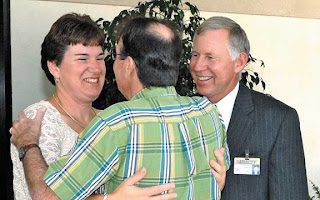
On that particular day, Ms. Hoogenbosch took the 9-1-1 call related to Mr. Hanneman, learning that he was unconscious and not breathing.

After sending firefighters and paramedics to the scene, she provided instructions to Mr. Hanneman's family that ultimately saved his life.

County Health Department representative Marc Burdick took the opportunity Monday to praise Ms. Hoogenbosch for ensuring that Mr. Hanneman's family members took every step possible to save his life until help arrived, particularly performing CPR.

"She kept telling them to keep going until we got there," said Mr. Burdick, who explained that a defibrillator was eventually used on Mr. Hanneman. "After the second shock, he started to get his heartbeat back."

The importance of CPR was a theme of the ceremony.

Dr. Angelo Salvucci, the medical director of the county's Emergency Medical Services, also expounded upon the vital role of the life-saving technique and said everyone should learn how to perform it.

"Because CPR was done and done correctly," he said, "...(Mr. Hanneman) is here to talk to us today."

Dr. Salvucci then pointed out that the saving of Mr. Hanneman's life was a process accomplished through a "chain of survival," in which "the link representing the dispatch" was especially crucial.

He emphasized the point that were it not for Ms. Hoogenbosch, Mr. Hanneman may not have been present at Monday's gathering.

"If any of you listened to the (9-1-1) tape, you'd understand," he said.

Mr. Hanneman spoke next, briefly but memorably.

"I just wanted to thank Shannon for her professionalism," he said. "All I know is that I survived, and I survived because of the efforts of everyone it took."

Santa Barbara County Undersheriff Ken Shemwell used his time to praise Ms. Hoogenbosch, explaining that she would not praise herself.

"She's going to act like, 'Well, this is not that big a deal; I was just doing my job,' " he said. "This is her second (Emergency Medical Dispatch) CPR Save Award."

He called Ms. Hoogenbosch's efforts "fantastic," emphasizing that while she is modest, others recognize the impact of her accomplishments.

"I'm even more pleased that Mr. Hanneman is here today," he said, turning to Mr. Hanneman, who wore an appropriately lively green shirt to the ceremony, and he added with a handshake, "It's great to have you here."

Ms. Hoogenbosch spoke very positively of the inspirational experience.

"It's a good feeling," she said and quickly corrected herself, saying, "It's an awesome feeling to know that you saved somebody's life."

She said one of the most important aspects of a dispatcher's work is insisting on calmness from someone who has been forced to call 911.

"The caller was pretty hysterical," she said. "You've just got to keep reminding them."

She provided some words of wisdom for those who ever have to call 911 for emergency services.

"I know the situation's hard," she said, "but just try to stay calm."

As for meeting Mr. Hanneman, Ms. Hoogenbosch described it as having "come full circle."

"I'm very modest and very quiet about it," she said, "but it's a great feeling."

Saturday, August 22, 2009

Woman plans to hula hoop 200 miles for a cause : She also has her sights on a long distance hooping world record

MORGAN HOOVER, NEWS-PRESS CORRESPONDENT

August 22, 2009 7:38 AM

Proving that staying fit can be fun and might even help make the world a better place, a Maricopa woman plans to hula hoop her way across 200 miles of the South Coast to raise awareness about the nonprofit organization where she is an intern.

Ahni Radvanyi, 23, currently interns at Quail Springs, described in its Web site as "a working farm dedicated to demonstrating and teaching holistic ways of designing human environments, and to facilitating deeper understandings of ourselves and one another through immersive experiences in nature."

"I want an adventure, and no one's set a record for long distance hooping," she said.

Ms. Radvanyi said she has hula hooped since she was a child, but she became especially passionate about it approximately four years ago.

"Any time there's good music around, you can't make me stop," she said laughing. "I don't do it every day; I do it when I feel called to do it."

Ms. Radvanyi said hooping has changed her perspective on health.

"It makes me feel so balanced afterward," she said, explaining that since she began hula hooping regularly, she has achieved greater body awareness and is "more comfortable in (her) own skin."

"It's another kind of yoga for me," she said. "It's mind and body."

Her favorite place to hula hoop is at Quail Springs.

"There's a hill ... that was considered the center of the Chumash Indian universe," she said. "Early, early morning is the best."

She now plans to take the activity to a new level by embarking on a hula hoop journey beginning Aug. 29 in Ojai, continuing through Ventura, Carpinteria, Santa Barbara and Goleta and ending in Gaviota.

Ms. Radvanyi said she hopes people will join her along these 200 miles because she wants to be encouraged.

"I want to see that they believe they can do it too," she said.

Ms. Radvanyi said eventually she would like to teach a hooping class, but right now she wants "to take on the world."

"I want to facilitate hoop jams," she said of the future, "but what I really want to tell people is to take your next step toward a healthier mind and body."

Symbolism is another important part of the activity for the adventurous hooper.

"I want people to see it as a metaphor," she said. "I want people to see the circle they're dancing in and be the change within it."

For more information on Quail Springs, visit quailsprings.org.

To join Ms. Radvanyi's hooping journey at any point or to gain more information, visit myspace.com/hoophike.

Friday, August 21, 2009

SBCAG urged to address sustainability in transportation plan

MORGAN HOOVER, NEWS-PRESS CORRESPONDENT

August 21, 2009 7:24 AM

Local environmental advocates on Thursday encouraged county officials to make further improvements to the sustainability of transportation in Santa Barbara.

The Santa Barbara County Association of Governments received a presentation and public feedback at the County Administration building of the new draft amendment to the Regional Transportation Plan's Environmental Impact Report of 2008.

A Santa Barbara County Superior Court judge ruled in June that SBCAG's certification of an associated program EIR was vacated, as it was "deficient with respect to energy setting, energy impacts analysis, and, to a limited extent, induced travel."

Aubrey Spilde presented the association with the draft EIR amendment, on which the public can comment on paper until Sept.. 4.

The amendment includes three key sections, including an "Induced Travel" section, which consists "of a new discussion of the potential for impacts related to induced travel;" an "Energy" section, which includes "additional description and quantification of current countywide energy use, supplementary regulatory setting and quantification of impacts and a "References and Preparers" section.

Public comment at the meeting produced statements that the association should continue improving the amendment.

K.K. Holland, the project coordinator for the Alliance for Sustainable and Equitable Regional Transportation, said the association should look at supporting the addition of a coastal rail line as a means of sustainable transportation.

"The (Regional Transportation Plan) really needs to do a better job of taking sustainability seriously," she said.

The Community Environmental Council was also represented during public comment by Michael Chiacos and Dave Davis.

"Transportation provides the impetus for over 50 percent of the greenhouse gases in Santa Barbara," said Mr. Davis, who said that he wants the plan to be made more "adaptable" for the future. "What we are looking at is a plan that does pretty good for today's conditions."

Mr. Chiacos agreed, saying the amendment is improved but still "uses old data and ignores recent trends."

"I ask that you take a look ahead," he said. "Alternative transportation allows us to use our current infrastructure more efficiently."

Mr. Chiacos called affordable transportation "a moral imperative," and said the "local data is surprisingly incomplete" in the amendment.

The association's staff will bring the amendment back at next month's meeting after addressing the responses from both the public and association members.

To view the full amendment and submit comment, go to sbcag.org.

e-mail: mhoover@newspress.com